What is domain authority and why is it important?
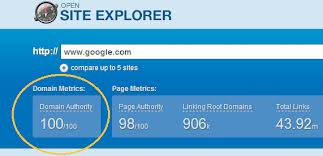
domain authority Google exampleYou may have read SEO articles which mention “domain authority” as being a key website ranking factor and wanted to know a little more? So what is it exactly?

Firstly it’s important to establish that domain authority is not an official Google metric; in fact it was established by “MOZ”, perhaps the largest and most highly respected authority on search engines outside of Google itself. They explain it as being a consolidated prediction of how well a website will rank in Google using a suite of metrics such as number of linking root domains, total number of back-links, trust signals, social media factors etc.

In fact they measure 40 separate factors and use machine learning to correlate these against Google’s algorithm in an attempt to model how search engine results are actually generated. So there is some heavy-duty number crunching behind this.

My own take on this is that the “domain authority” calculation is likely some way off when compared to what Google actually does, in fact there are lots of examples that prove this. However, it is also fair to say that the consolidated DA figure which pops out of MOZ’s calculator provides an excellent way of comparing different websites and then tracking how they fare in Google over time. Using this tool you can get a very good idea of the “strength” of your website and also that of your competitors.

How can I improve domain authority for my own website?

(more…)

What is “Internal Marketing” and why is it your first priority

Text books will define “internal marketing” as the process whereby the employees and processes within an organisation are aligned and developed to deliver the most effective and pleasing experience for customers. In turn, a delighted patient is more likely to recommend your services to others.

In the dental marketing context you will also see the term used, perhaps slightly inaccurately, to describe the tools used within a practice to help promote and sell services, for example use of video in the waiting room, promotional posters etc.

It’s easy enough to see why all of these elements are extremely important, so putting semantics and definitions to one side for a moment, let’s take a closer look at internal marketing techniques for dentists.

Why is it so important?

(more…)

Can a DIY dental website present a professional image for your practice?

Occasionally we receive enquiries where the caller is considering a DIY dental website builder for their practice and wishes to know the pros/cons of that option versus a bespoke design. The type of site builder they’re talking about are the ones you will see offered by some marketing and web hosting companies, typically for a set monthly fee. On the face of it, this may look like an easy and cost-effective option but is it really all it seems on first inspection?

As with all purchases, it’s important to evaluate exactly what you are getting and the real value on offer. To assist you with such an assessment, here are the pros and cons of DIY dental websites builders:

Pros

  • The only obvious benefit is the facility to spread cost using monthly payments. Most services of this type come bundled with a hosting arrangement and do allow you to pay monthly. But, as a quick calculation will show, in less than 18 months you will have paid enough to have purchased a professionally designed site outright.

Cons

The negatives associated with DIY web builders significantly outweigh the positives:

(more…)

Reviews are important for search ranking and reputation management – here’s how to encourage them….

Google reviews are known to be an important factor for helping a website to appear prominently in the “local” search results as well as a powerful mechanism for building reputation. Consequently it is important to seek positive patient reviews to help promote your dental practice.

But here’s the problem. The process to leave a review on Google is not entirely straightforward and your patients, even your strongest proponents, are fickle when it comes to using their precious time to leave you a rating. I imagine we’ve all done it? How many times have you been to a restaurant, had a great meal and thought about leaving a positive review on Google? Only then to get home and forget all about it as the daily routine takes precedence? Probably lots of us?

The situation is made a little more convoluted in that you need a Google account to leave a review – so not only do you have to locate the business on the web, but also set up a Google account to make the review. For most, this is a bridge too far, even though in reality it only takes a few minutes.

So what can be done to facilitate the process?

(more…)

What does this mean and why is it important for your dental practice website?

Before we delve in, here’s a simple explanation of what is meant by “above the fold”. This is basically the content, images and/or text, which appears on the screen when a user lands on your page without the need to scroll down to see more.

Planning your content “above the fold” is important for a couple of reasons, primarily encouraging instant user engagement and also for SEO. Let’s start by taking a look at user engagement……..

Designing above the fold to promote user engagement

First impressions count everywhere and this is also true for effective website design. Would you rather be confronted by a scree of text or an element which is going to catch your attention, tell you quickly and succinctly that you are in the right place and encourage you to investigate further? Pretty obvious I think. So what are the main elements to consider?

Titles

(more…)

How the structure of your site affects user experience and SEO.

representation of web page hierarchyA key element of the dental website design and planning process is the configuration of the navigation structure and hierarchy of the information pages within the overall framework. This is essential for two main reasons, the user experience and SEO, both of which need to be considered very carefully.

It is generally considered that larger websites work better for SEO – this is because Google puts great emphasis on good quality content which has sufficient depth and value to be considered worthy of ranking above similar but less well structured material.

Of course, off-site factors such as the links which point back to your pages, also play a significant part in search ranking, but the initial foundations must be built with a focus on good quality content and how it is structured within the dental website.

Search position is not the only factor – if we consider user experience, content which is configured well and linked together within an intuitive navigation structure, will certainly help to keep a user on your website and help guide them through to your contact form.

So we can see that the structure of your website and the quality and depth of the content therein, play very important roles both for ease of use and for your ranking position.

The pyramid effect and page rank – how does this affect SEO?

(more…)

Don’t make these mistakes in 2014.

eliminate mistakes signWith a plethora of New Year marketing “to do” lists widely available, I thought I’d quickly switch the topic on its head and compile a quick list of what NOT to do when considering your dental web marketing for 2014.

Here are 11 important areas to address:

(more…)

Optimisation for mobile

A few days ago, Matt Cutts of Google tweeted statistics which indicated that mobile web browsing had nearly doubled over the last year. In line with this he also made a firm recommendation that optimising for mobile should be a top priority for all webmasters in 2014.

Previous experience suggests that when Google make such recommendations, it is a good idea to act upon them. Where you follow Google’s guidelines correctly, your efforts will likely result in your website faring better in the search results as well as providing a better user experience.

When trying to determine why Google rewards optimisation of this nature, it is worthwhile remembering that high on their list of priorities is delivering the most appropriate search results for users. A large part of this is determined by how well your website is structured and whether it performs well on all types of devices whether, desk-top, tablet or mobile. With the mobile browsing element increasing so rapidly, it’s clear to see why Google is encouraging you to get your mobile assets in shape as soon as possible. In doing so, you will be in great shape to accomplish two important things:

  • improving usability for your users
  • improving your search ranking positions

Optimising your dental website for mobile viewing

(more…)

Is a customised app for dentists a good idea?

In recent weeks we’ve been approached a couple of times to give advice about apps for dentists – not the type which provide clinical advice and technical references but for marketing purposes.

I thought it worthwhile to summarise our recommendations and thoughts on where your own dedicated app should sit in your list of dental marketing priorities.

But first, for those who are unfamiliar, it may be useful to define what an app actually is.

What is an app?

(more…)

Why migrating your website to Dental Media makes sense

illustrating excessive cost of dental website maintenanceDo you ever look at your dental website hosting and maintenance bill and wonder what you are actually getting for it? Is it good value? Are there alternatives? The answer is unequivocally “yes”.

I’m prompted to revisit this topic following two calls from dentists this week who were keen to seek an alternative supplier after the incumbent marketing company raised their prices by 15%. At a time when inflation is bubbling around 2%, this seems quite hard to explain?

Over the last few years it has become increasingly important for small businesses to examine their costs in fine detail and this includes their web maintenance and marketing spend. Historically, there has been a tendency for dental marketing companies to push monthly maintenance contracts onto dentists where, in most cases, this is unjustified.

These types of contracts typically offer small website updates and security patches for which you are expected to pay £750 -> £1000 + per year. You will also get the website hosting included in the fee. Considering that most dental practices will only make 5 or 6 updates to their website every year and that professional hosting can be purchased for less than £100, that’s an awful lot of cash for not much return. In reality, all you are doing is providing a guaranteed monthly income stream for the dental marketing company which they desperately need to cover infrastructure costs. This, of course, is why they push so hard to sign you up. Whilst I’m not suggesting that companies should work for free, I am suggesting that the value offered from this type of arrangement is often poor.

What are the alternatives?

(more…)