
Pay-per-click, SEO or both?

Why sole reliance on PPC (AdWords) is a questionable marketing strategy.
 Acquiring new dental patients from the web can be achieved in several ways; the main channels being via the free search results, pay-per-click advertising in the search engines or advertising via social media channels.
A balanced digital marketing strategy often includes all of these elements but sometimes we also see a dentist elect to pursue just one of them. In this blog post we will take a look at why some dental practices eschew search engine optimisation (SEO) in favour of pay-per-click and why this may not be a sensible, sustainable strategy.
Pay-per-click and SEO – quick definitions
Before we discuss further, it’s worth a quick recap on what SEO and pay-per-click (PPC) actually are, particularly for those who may just be starting out on their digital marketing journey.
SEO is all about improving the search results for website pages, primarily in Google (94% of all searches in the UK are made via Google). This can be done in many ways including techniques to optimise the “on-page” and “off-page” factors associated with a website. So ensuring that the website is set up correctly in the first instance and then building up the collateral around it elsewhere on the web. You will hear terms such as link-building, blogging, speed-optimisation etc which all need to be done methodically and professionally to move a website forward in the ranking results.
Pay-per-click is a method whereby you bid against others to place your advert in Google. In general terms, higher bids secure higher ad. placement with the intention that users click on your advert rather than your competitors. Each time your ad is clicked, you pay a fee to Google in their AdWords programme. You then hope that the user finds something attractive on your landing page and chooses to do business with you. As with SEO, configuring and managing PPC needs experience and skill to realise the best rewards.
So that is a very quick overview of the two methodologies, but is either one better than the other when it comes to securing new dental patient enquiries?
When are these strategies used?
 To establish and then maintain prominent search engine positions, your website needs to excel in several areas. Too often you see dentist’s websites which look good but languish on page 2 or 3 of Google and likely deliver very few, if any, new patients to the practice.
 The need for mobile-optimised or “responsive” websites is well-understood and now widely adopted by the majority of dental practices who are serious about their web presence. For those who are still lagging behind, the disadvantages of providing poor user experience and lower Google ranking are very real.
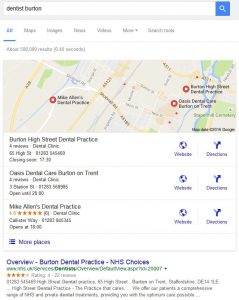 This may sound rather an odd topic but what I hope to illustrate quickly in this article, is that you really must consider patient acquisition from the web when deciding where to build, or buy, a dental practice. The key factors to consider are Google local search and also the level of existing competition in the main search index. These two elements alone can have a huge bearing on how easy, or difficult, you will find it to acquire new patients who are searching on the web for dental services.
 Elsewhere in the Dental Media blog we’ve discussed the pros and cons of content management systems (CMS) and whether or not you need to implement one for your practice website. On the upside they can be useful for making minor changes to text but on the downside, for anything more detailed you will likely need the assistance of your web designer. There are also the security and maintenance issues to understand. But with these limitations understood, you should be able to make an informed choice about whether or not you want to use a CMS.
 It won’t come as much of a surprise that, when consumers are shopping for products and services, including dentistry, they are attracted to websites which use high-quality, engaging imagery more-so than sites which are text heavy with few, low quality photographs.
 A good quality website should serve you well for several years, but you should still expect to make periodic updates to an existing design and then carry out a more extensive, structural update every 3 or 4 years. In this blog we take a look at why this is and why you simply can’t leave your website untouched in the hope that it will continue to perform optimally.
 Here at Dental Media we have a reputation for transparency and flexibility and we strive to work with clients to deliver the most cost-effective and professional solutions in line with their budget.
 There is an apparent trend at the moment for dental practices to try out Facebook marketing, perhaps on recommendation from their marketing company, business coach or from what they’ve read in the media. Many practices are also trying it under their own steam in true ‘DIY’ style. But is Facebook marketing really the route to lots of valuable new patient enquiries or are there some pitfalls along the way?