Domain names and how they fit into your web strategy

Your website domain name is an extremely important asset and one which warrants careful selection and ongoing care. Your domain name is the ‘sign-post’ on the web that points to your website and without it, your website and blog will stop working.

We are often asked for advice when clients are selecting a domain name, so here are a few tips and some guidance which will hopefully serve as a useful reference.

(more…)

…and why it’s not just about Facebook and Twitter

Whilst Facebook and Twitter are still the two power houses of social media, other platforms are developing quickly and should not be ignored when seeking to build your web profile and increase your overall reach on the web.

Social media has been around for several years and its value for stimulating user engagement is clear. However, more recently, social media has become increasingly important for improving search engine ranking. There are two main reasons for this:

a) Google has acknowledged that “social signals” generated by likes, shares, comments and re-tweets etc are being accounted for in the algorithm they use to determine where a website should rank.

b) Social channels are the conduits via which you can distribute useful content to your audience, not just for engagement but also for stimulating back-linking to your website – part of a process called content curation. This is proving to be a very useful technique in our web marketing campaigns for dentists.

So “social” is growing in importance and any web marketing strategy must incorporate it.

A quick look at the main social channels and how to use them:

main social media channels

As I noted earlier, whilst Facebook and Twitter are still the main channels, tools like Google+ and Pinterest are growing very quickly and should be considered in the marketing mix. We discuss the main resources and priorities below….

(more…)

What is it and why is it useful for online marketing?

Up until fairly recently, the basics of online marketing consisted of a decent website and then building back-links to it to gain prominence in Google. However, as we’ve explained in recent blogs, successful online marketing now requires a multifaceted approach and the use of supporting online channels. Good dental marketing strategies, particularly for those practices operating in competitive environments, will be underpinned by blogging, social media, video publication and more. So whilst a professional website is the cornerstone of your online campaign, depending on your niche and local competition, stood alone it may not be enough.

A typical online marketing infrastructure we use with our dental clients incorporates the following:

(more…)

Leveraging the power of the web to market your dental practice

Would you like to know your customers better? Want to know what they think about your practice? Would you like to see more traffic to your website and more enquiries? Could you communicate with your customers more effectively? If yes, to any of these it may be time to invest in improving your dental practice’s online presence.

Online dental marketing is vitally important to any business, dental practices included. These days it is not enough for dentists to simply rely on word of mouth or a phone book listing, particularly for those practices offering cosmetic dentistry, which is especially competitive.  With the inception of Netbooks, Smartphones and Wi-Fi the internet is bigger than ever and as technology advances so it will too. It is estimated that there are over 1,000,000,000 Google searches every day! This astonishing figure highlights how reliant people are on the internet, using it as their primary resource for information.

(more…)

How we manage new website projects at Dental Media

One of our core values at Dental Media is offering completely flexible web projects for our clients i.e. a fully bespoke approach. We find that most of our clients appreciate this because they do not wish to be pressed into design packages that don’t fully meet their requirements or budgets.

Kevin Manners Dentures and ImplantsZenith Dentistry


A bespoke design process means that you can select exactly how many pages you need for your website, the type of content management system, design for mobile etc. without feeling that you need to purchase a “Gold” or “Exclusive” package or similar to access the latest features. So whilst we are always there to guide and do the “leg work”, you are always in control of your project.

An overview of our design process:

(more…)

Best practice for configuring back-links

As part of our marketing campaigns for dentists, we always encourage practice staff to seek out good quality back-links to their website to supplement the search engine optimisation work that we do on their behalf.

We regularly find that the dentists and practice managers have good relationship with suppliers and can often glean some very useful links from authoritative websites. As part of this link acquisition process it’s useful to know how a link should be configured and also how to ensure that the linking site is suitable.

A quick recap on why links to your website are useful

(more…)

New website technologies coming to the fore

The web is still a relatively new communications medium, first becoming a commercial platform in the mid nineties. Since then, the web or more formally ‘Internet’, has evolved rapidly to become a key feature, with research suggesting that many of us spend several hours per day on-line. The pace of Internet development is fast with new web authoring tools and technologies appearing all of the time.

At Dental Media we are always looking for new ways to improve our clients’ websites to help them differentiate from the competition – here are a few recent website developments which we expect to become standard features as 2013 progresses:

Responsive design

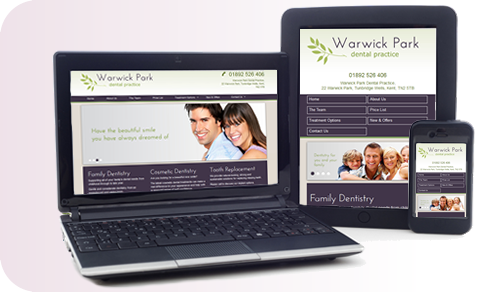
This technique allows a website to display optimally on all devices, whether a desk-top, tablet or mobile ‘phone. We’ve been producing ‘responsive’ websites for our clients for the last 8 months and the technique is covered in more detail here. We expect the majority of our new dental websites to be built responsively, virtually eliminating the need for a separate mobile site.

Responsive design for dentists websites

(more…)

Controlling dental marketing costs

I’ve been following a couple of threads on dental forums and blogs with interest. One was by coach Chris Barrow on his blog, the other was a thread in the GDPUK forums. Both reflected on the state of UK dentistry and developed into discussions about the pressing need to control operating costs in the face of the mounting financial pressures and static revenues across the industry.

Falling dental profitsDrawing together a very generalised summary, particularly of the GDPUK thread, comments suggested that the level of “high end” cosmetic and complex restorative procedures are down which has impacted significantly, even for well-established dentists. For less well-established guys, many with sophisticated dental “spas” and high operating costs, the cost/revenue/profit balance could not be maintained, sadly resulting in closure for some. This would have been unthinkable for many back in 2008 before the financial crisis really started to take hold. Back then, few would have considered that dental practices would close due to lack of profitability, or indeed that graduate dentists would struggle to find work.

This rather disturbing back-drop prompted me to revisit how a dental practice might contribute to cost savings by reviewing its marketing spend i.e. which areas deliver best return-on-investment and where, typically, they should be able to reduce spend without compromising on effectiveness. Whilst this may seem like quite a minor area, it is surprising how much can be saved by a rigorous review and adjustment of a marketing budget.

(more…)

What is “bounce rate” and what can I do to minimise it?

Bounce rate is used to measure the number of visitors to your website who only view a single page i.e. they do not progress further through the site. This is a very important metric as it serves as a high-level performance indicator for the quality of the page – high bounce rate typically implies that the page is not meeting the requirements of the viewer.

So exactly how do we measure bounce rate and then reduce it?

(more…)

With new Google updates imminent, is your site safe from penalty?

If you take a look back through our blog under the ‘SEO’ categories, you will find several posts which detail how Google made dramatic changes to its search index during 2011 and 2012; the two most significant changes being the “Panda” and “Penguin” updates.

With “Panda”, Google removed many websites with poor quality content which existed primarily to provide links. Article sites, even the well known ones, disappeared virtually overnight along with the rankings of websites that used these as their major source of back-links.

The “Penguin” update did something different, this time identifying sites that over-optimised by building lots of low quality links, often with the same keyword anchor text. Sites like this typically received a poor link warning from Google and within days, disappeared from the rankings.

(more…)