
Are you ready for Google voice search?

How voice search will affect SEO
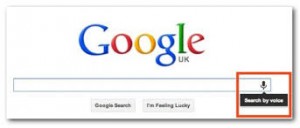 Before we start, don’t panic! The introduction of voice search by Google doesn’t mean that everything on your dental website needs to be restructured immediately.
However, I will use this as another illustration of how fast the “world of search” changes and how we as professional search marketers need to stay abreast and modify our marketing campaigns accordingly.
What is Google voice search?
This is a product from Google that allows you to use their search engine by speaking via a microphone on your PC, tablet or mobile. Early reviews suggest that it is quite accurate and more useful than the ‘Siri’ engine developed by Apple. One thing to note is that the system has not been rolled out universally yet – it is available via the Chrome browser and numerous mobile devices but as yet only for selected languages and locations. An earlier version of the product “Google Voice” has been around for a few years but in very limited formats – this vastly upgraded version suggests that Google really does mean business for a much more comprehensive roll-out soon.
How will this effect the way people search and SEO?
We need to take a lead from Matt Cutts here, Google’s main customer facing guy when it comes down to how search is evolving:
“It is definitely the case that if you have something coming in via voice, people are more likely to use natural language. They are less likely to use search operators and keywords and that sort of thing and that is a general trend that we see.” – Matt Cutts
Quite logically, if you can talk to your machine you are much more likely to use natural language rather than truncating to a few keywords that you type in a search box. An example might be that someone speaks “where can I find a really good implant dentist” rather than typing in “implant dentist London”. Almost certainly the search engine companies will be looking at the best ways to deliver the best results for these conversational type queries.
Longer queries
We should also expect spoken search queries to become longer and Google will need to interpret this to pick out the relevant sections to present a suitable set of results. What we are seeing here is the rapid evolution of search engines, arguably led by Google, to understand the contextual relevance of a spoken query as well as what is written on a web page i.e. way in advance of simply spotting isolated key words.
How can I prepare my website content to facilitate this new type of search?
We’ll cover this in more detail soon but in simple terms “think natural”. The days of stuffing keywords into a web page are gone and now its all about providing natural and contextually relevant text which accurately describes the topic in hand. Clearly it is still important to ensure that the keyword appears once or twice but don’t worry about jamming them all together to try and mimic what a user might type into Google.
Remember that Google is now much more adept at interpreting the contextual relevance of a web page and indeed the latest spoken search queries, so keep this in mind when you are compiling your website text. Natural = good!
Summary
At Dental Media we spend time staying abreast of the latest developments from the search engines and how we can use this to best effect for our clients. Our web page and blog copy writers have already taken Google’s recent changes on board and are generating content that is proven to work well for the reader and also for SEO. If you are interested in this or any other aspect of search marketing for you website, please call us on 01332 672548.