
The changing face of dental website SEO

With new Google updates imminent, is your site safe from penalty?
If you take a look back through our blog under the ‘SEO’ categories, you will find several posts which detail how Google made dramatic changes to its search index during 2011 and 2012; the two most significant changes being the “Panda” and “Penguin” updates.
With “Panda”, Google removed many websites with poor quality content which existed primarily to provide links. Article sites, even the well known ones, disappeared virtually overnight along with the rankings of websites that used these as their major source of back-links.
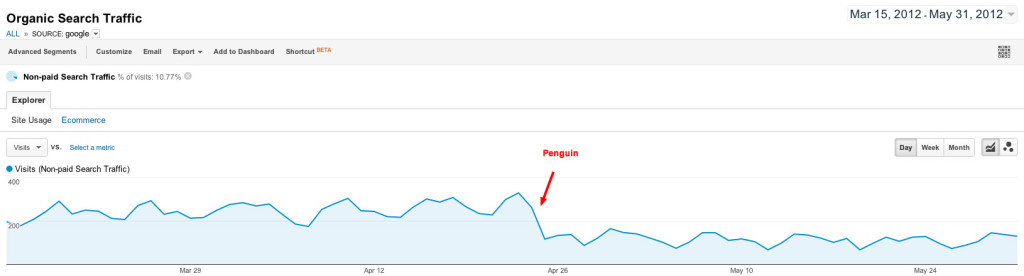
The “Penguin” update did something different, this time identifying sites that over-optimised by building lots of low quality links, often with the same keyword anchor text. Sites like this typically received a poor link warning from Google and within days, disappeared from the rankings.
A number of dental marketing companies who used these cheap and unsophisticated link-building tactics were penalised by Google; both their own websites and worse, those of their clients. Invariably, link-building was being outsourced to cheap off-shore suppliers and Google finally caught up!
These penalties are not trivial!
Google was not messing around when it introduced these penalties – ranking penalties of 5 to 6 months are not uncommon and recovery takes an awful lot of work. This includes cleaning up link profiles, deleting the bad and replacing with good. Unfortunately, a lot of SEO companies are still peddling the same tactics and continue to risk their clients websites and livelihood.
This is what happens to your web traffic after a Google penalty:
Another update, Penguin 2, is just around the corner
A few days ago, Matt Cutts, the guy in charge of Google’s web spam team, announced that the next round of Penguin updates is imminent – within a couple of weeks. He also announced that this round will cut even deeper than the original update i.e. identifying more low quality links and potentially penalising more websites.
The upshot of this is that if you have been engaged in low-spec link-building but got away with it last time, this time there is a high likelihood of being caught out. If your back-link profile is suspect, then your SEO team really should have been checking this out and adjusting to make sure that you don’t get penalised this time around. Frankly, if they haven’t, it’s now probably too late.
What can you do if you think your dental SEO provider has messed up?
Whilst the penalties dished out by Google are harsh, they can be overcome. The first thing is to have your website and back-link profile audited by a recognised SEO professional to assess the damage and propose recovery actions. This will include removal of poor links and a programme of ethical SEO to compensate. At the appropriate time, it may be prudent to submit a re-inclusion request to Google after a comprehensive clean-up has taken place. At Dental Media we have recovered several sites where dentists have been hit by poor SEO – we will be pleased to audit your website and advise.
Summary
Google continues its purge on web spam and poor SEO with another major update just around the corner. More updates can be expected as Google continues its quest to demote websites which have employed spammy techniques in an attempt to improve their search engine positions. Low specification, cheap SEO is simply dangerous – please don’t engage in it.
If your dental website has been hit or if you suspect that your SEO team isn’t taking action to ensure that your website remains safe, please call our team on 01332 672548 for professional web marketing advice.